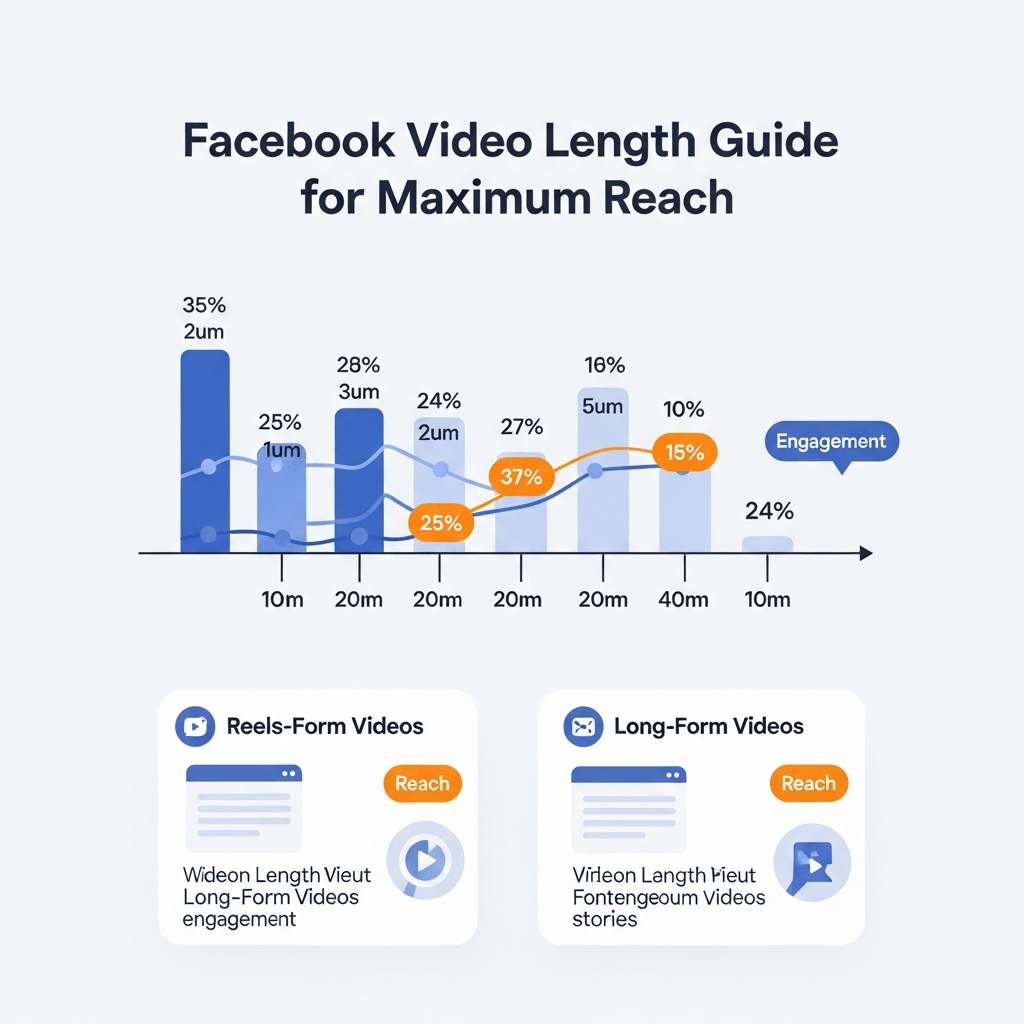
Getting video length right on Facebook can make or break your content strategy.
Too short, and you miss the chance to tell your story. Too long, and people scroll past.
The sweet spot? It depends on where and how you’re posting.
This guide breaks down exactly how long your Facebook videos should be for each format. You’ll learn what works, what doesn’t, and why it matters.
Why Video Length Matters on Facebook
Facebook’s algorithm cares about watch time more than anything else.
A video that keeps people watching signals quality to the platform. Facebook then shows it to more people.
But here’s the thing: different video formats have different rules.
What works for a feed post won’t work for a Reel. Stories need different timing than Facebook Live.
Get the length wrong, and your content dies in the algorithm. Get it right, and you’ll see your reach explode.
How Facebook Measures Video Performance
Facebook tracks several metrics to judge your video quality.
Average watch time shows how long people stick around. Higher is better.
Completion rate reveals what percentage watched the whole thing. This matters a lot.
Retention rate indicates where people drop off. It helps you spot weak points.
The algorithm doesn’t just count views. It measures engagement depth.
A 2-minute video where people watch 90 seconds beats a 30-second video where they watch 10 seconds.
Think quality over quantity, but with strategic length choices.
Optimal Length for Facebook Feed Videos
Feed videos work best between 1 and 3 minutes.
This range gives you enough time to deliver value without losing attention.
Videos under 30 seconds often feel incomplete. People want substance.
Videos over 5 minutes see massive drop-offs. Unless your content is gripping, keep it tight.
The data backs this up. Videos around 2 minutes get the highest completion rates.
You can tell a complete story in this timeframe. There’s room for a hook, value delivery, and a call to action.
Quick tip: Aim for 90 seconds if you’re unsure. It’s the Goldilocks zone.
Facebook Reels Length Strategy
Reels changed the game when Facebook introduced them.
The maximum length is 90 seconds, but shorter often performs better.
15 to 30 seconds is ideal for entertainment content. Quick, punchy, rewatchable.
30 to 60 seconds works for educational or tutorial content. You can explain something useful without rushing.
60 to 90 seconds suits storytelling or before-and-after content. You have room to build narrative.
Reels favor quick consumption. People swipe fast. Hook them in the first second.
If your content needs more time, consider breaking it into a series. Part 1, Part 2, and so on. This builds anticipation and following.
Facebook Stories Duration Guidelines
Stories disappear after 24 hours. They’re meant to be quick and casual.
Each story segment can be up to 60 seconds, but shorter is smarter.
5 to 15 seconds per segment keeps people tapping through your entire story sequence.
Post multiple short segments instead of one long one. Three 10-second clips beat one 30-second clip.
Why? Because each tap signals engagement to Facebook. More taps mean more distribution.
Stories are for quick updates, behind-the-scenes peeks, and time-sensitive content.
Think of them as snapshots, not films.
Facebook Live Video Optimal Duration
Live videos follow completely different rules.
Facebook actually rewards longer live streams with more distribution.
Minimum 10 minutes is recommended. Shorter than this, and you’re not taking advantage of the format.
20 to 30 minutes is the sweet spot for most content. You can dive deep without exhausting your audience.
30 to 60 minutes works for interviews, Q&As, or detailed tutorials.
Why longer? Because live videos get priority placement in feeds while they’re happening.
The longer you stream, the more people get notified. More people join mid-stream.
Facebook also promotes your live video with notifications to followers. A 5-minute live stream wastes this opportunity.
Plus, your live video stays on your page after the stream ends. It continues generating views and engagement.
In-Stream Video Ads Length
If you’re running video ads, length directly impacts performance and cost.
15 seconds is standard for most ad campaigns. It’s long enough to deliver a message without annoying people.
6 seconds works for bumper ads. These non-skippable shorts need to be punchy and memorable.
30 seconds to 1 minute suits product demonstrations or testimonials. You have time to build a case.
Longer ads cost more and see higher drop-off rates. Unless you’re retargeting warm audiences, keep ads short.
The first 3 seconds are critical. If you don’t grab attention immediately, people scroll.
Test different lengths. Your audience and product might prefer different timing.
How Video Length Affects Reach
Facebook’s algorithm prioritizes watch time over video length.
But here’s what happens with different lengths:
Very short videos (under 30 seconds) get quick views but low watch time. They might get lots of views but less algorithmic push.
Medium-length videos (1-3 minutes) balance completion rate and watch time. They typically get the best organic reach.
Long videos (5+ minutes) get fewer views but higher total watch time from committed viewers. Facebook values this engagement.
Your goal: maximize both completion rate and total watch time.
A 2-minute video with 80% completion (96 seconds average watch time) will outperform a 5-minute video with 30% completion (90 seconds average watch time).
Content Type and Length Matching
Different content types need different durations.
Product demos work best at 60 to 90 seconds. Show the problem, demonstrate the solution, add a call to action.
Tutorials need 2 to 3 minutes. You need time to explain steps clearly.
Behind-the-scenes content thrives at 30 to 60 seconds. Quick peeks work better than lengthy tours.
Customer testimonials should be 45 to 90 seconds. Long enough for credibility, short enough to maintain interest.
Announcements need just 30 to 45 seconds. Get to the point fast.
Entertainment content varies widely. Comedy skits work at 15 to 30 seconds. Story-driven content can run 2 to 3 minutes.
Match your length to your content purpose. Don’t stretch content to hit a time goal.
Testing and Optimizing Your Video Length
Don’t guess. Test.
Post the same type of content at different lengths. Compare performance.
Check your Facebook Insights. Look at the audience retention graph.
Where do people drop off? That’s your answer.
If 70% of viewers leave at the 45-second mark, your videos are too long. Cut them to 40 seconds.
If completion rates are high but total views are low, try going slightly longer. More watch time might boost algorithmic distribution.
Run A/B tests. Post similar content with different durations on different days. Track the results.
Your audience tells you what they want through their behavior. Listen to the data.
Mobile Viewing and Length Considerations
Most Facebook users watch on phones. This affects ideal video length.
Phone viewers have shorter attention spans. They’re often multitasking or on the go.
Keep mobile videos tighter than desktop videos. Aim for the lower end of recommended ranges.
Vertical videos (9:16 ratio) can be slightly longer because they fill the entire screen. They’re more immersive.
Horizontal videos take up less screen space on mobile. Keep these especially short.
Test your videos on your phone before posting. If you’d scroll past it, so will others.
Common Video Length Mistakes
Mistake 1: Making every video the same length regardless of content. Different messages need different durations.
Mistake 2: Front-loading videos with long intros. Get to the point in the first 3 seconds.
Mistake 3: Ending abruptly without a conclusion. Give people a reason to act or a satisfying ending.
Mistake 4: Stretching thin content to hit a time goal. 60 seconds of value beats 3 minutes of filler.
Mistake 5: Ignoring analytics. Your data shows exactly what length works for your audience.
Mistake 6: Copying competitors without testing. What works for them might not work for you.
Mistake 7: Making videos too short to tell the story. Don’t sacrifice clarity for brevity.
Platform-Specific Length Comparison
How does Facebook compare to other platforms?
YouTube favors longer content. Videos over 8 minutes can include mid-roll ads. The algorithm rewards watch time, so longer often wins.
Instagram Reels max out at 90 seconds, just like Facebook Reels. But Instagram users prefer the 15-30 second range even more.
TikTok allows up to 10 minutes now, but videos under 60 seconds still dominate. The culture favors quick content.
Twitter videos can run 2 minutes and 20 seconds. But tweets with video under 45 seconds perform best.
Facebook sits in the middle. It supports longer content than Instagram or TikTok, but shorter than YouTube.
If you’re repurposing content across platforms, edit for each one. Don’t just post the same video everywhere.
Creating Content for Different Audience Segments
Your audience isn’t one person. Different segments prefer different lengths.
New followers have shorter attention spans. They don’t know you yet. Keep videos under 60 seconds for cold audiences.
Engaged followers will watch longer content. They trust you. You can go 2-3 minutes with warm audiences.
Customer segments want depth. They’re invested in your product or service. Educational content for customers can run 3-5 minutes.
Segment your content strategy by audience warmth. Use Facebook’s targeting to show different length videos to different groups.
Quick Reels for discovery. Medium-length feed videos for engagement. Longer content for your loyal community.
Practical Tips for Any Video Length
Whatever length you choose, these rules always apply:
Hook viewers immediately. The first 3 seconds determine if people keep watching.
Add captions. Most people watch without sound. Captions increase watch time by 12% on average.
Keep important content in the middle third. Don’t save your best point for the end. Many won’t make it there.
Use pattern interrupts. Change scenes, angles, or visuals every 5-7 seconds. This maintains attention.
End with a clear call to action. Tell people exactly what to do next.
Optimize for silent viewing. Visual storytelling matters more than dialogue.
Tools for Tracking Video Performance
Use these tools to monitor how length affects your results:
Facebook Insights shows average watch time, completion rate, and audience retention graphs. This is your primary tool.
Facebook Creator Studio gives deeper analytics. You can compare multiple videos side by side.
Third-party analytics tools like Sprout Social or Hootsuite provide cross-platform comparisons and easier reporting.
When analyzing competitor content, especially Reels, many marketers look for facebook reel download hd quality options to study successful videos frame by frame and understand what makes them perform well.
Check metrics weekly. Look for patterns. Adjust your strategy based on what you learn.
Future Trends in Facebook Video Length
Video preferences are shifting. Here’s what to watch:
Shorter attention spans mean even optimal lengths might decrease. What works today might be too long next year.
Vertical video dominance continues growing. Full-screen formats allow slightly longer content because they’re more engaging.
Interactive features like polls and questions can extend effective video length. They re-engage viewers.
AI recommendations are getting smarter. The algorithm may start personalizing video length recommendations by user.
Stay flexible. Test constantly. What works today might change tomorrow.
Frequently Asked Questions
What’s the ideal length for a Facebook video?
It depends on the format. Feed videos work best at 1-3 minutes. Reels should be 15-60 seconds. Stories need 5-15 seconds per segment. Live videos should run 20-30 minutes minimum. Match length to content type and placement.
Do shorter videos always perform better on Facebook?
No. While shorter videos often get higher completion rates, Facebook rewards total watch time. A 2-minute video with 70% completion can outperform a 30-second video with 90% completion because it generates more watch time.
How long should Facebook video ads be?
Most video ads work best at 15 seconds. This balances message delivery with user tolerance. For detailed product demos, you can go up to 60 seconds. Bumper ads should be exactly 6 seconds.
Can I post videos longer than 3 minutes on Facebook?
Yes, Facebook allows videos up to 240 minutes long. But longer videos typically see lower completion rates and less organic reach. Only go long if your content justifies it and your audience is highly engaged.
How does video length affect Facebook algorithm?
The algorithm prioritizes videos that generate high watch time and engagement. It’s not about raw length, but about retention. A well-crafted 2-minute video will beat a poorly made 5-minute video every time.
Should Facebook Reels be 15 or 90 seconds?
Start with 15-30 seconds. This range gets the highest completion rates and repeat views. Only use 60-90 seconds if your content requires more time to deliver value. Entertainment content should be shorter. Educational content can be longer.
How do I know if my videos are too long?
Check your audience retention graph in Facebook Insights. If you see a sharp drop-off at a certain point, that’s where you’re losing people. If less than 50% watch past the halfway mark, your videos are too long.
Does Facebook Live need to be long?
Yes, longer is better for live streams. Facebook promotes live videos with notifications, and these roll out over time. A 20-30 minute stream gives more people time to get notified and join. Plus, you can save longer streams for on-demand viewing later.
Your Action Plan
Here’s what to do right now:
Choose one video format to focus on first. Master that before adding others.
Create 3-5 test videos at different lengths. Post them over two weeks.
Check your analytics. Compare completion rates, reach, and engagement.
Double down on what works. Cut what doesn’t.
Video length isn’t one-size-fits-all. Your audience is unique.
Test, measure, adjust, repeat. That’s how you win on Facebook video.
Start today. Your next video could be the one that breaks through.
 Daily Lens
Leave a comment